
Can You Mount a TV on Drywall Without Studs?
Santa Clarita TV Mounting explains how a TV is mounted on a wall where the studs are not where the TV needs to go — toggle anchors rated for the load, steel-stud condos, backer plates and the earthquake-country margin that Santa Clarita Valley installers build in.
Bookings aren't open yet. Leave your name and number; your message is recorded, and you'll get one message when a local installer is available.
The wall as it starts
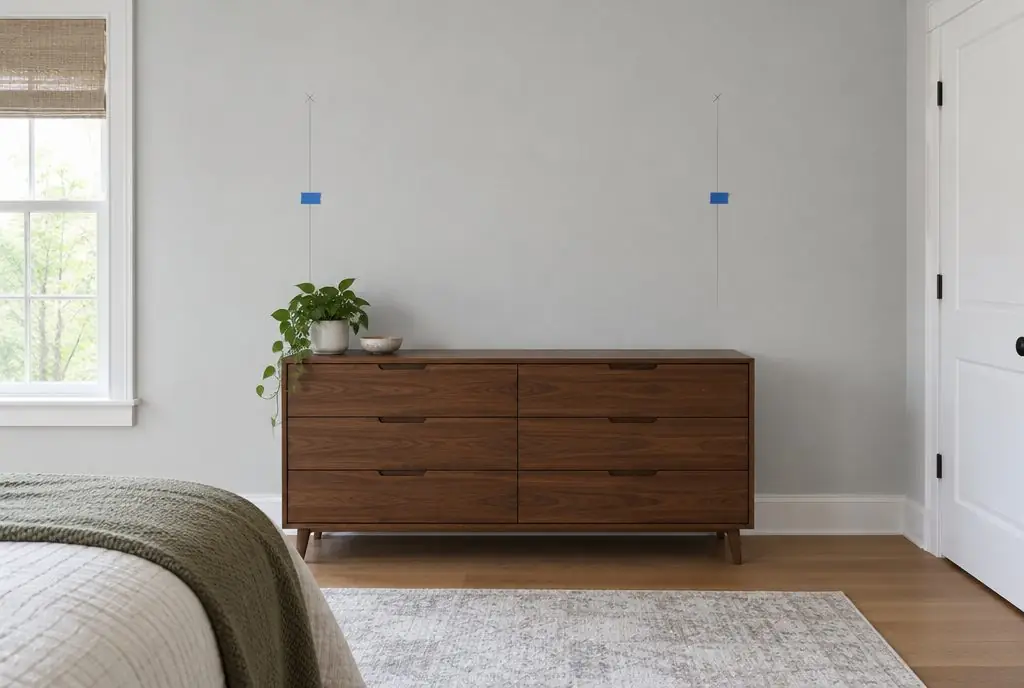 Illustration
The finished look (illustration)
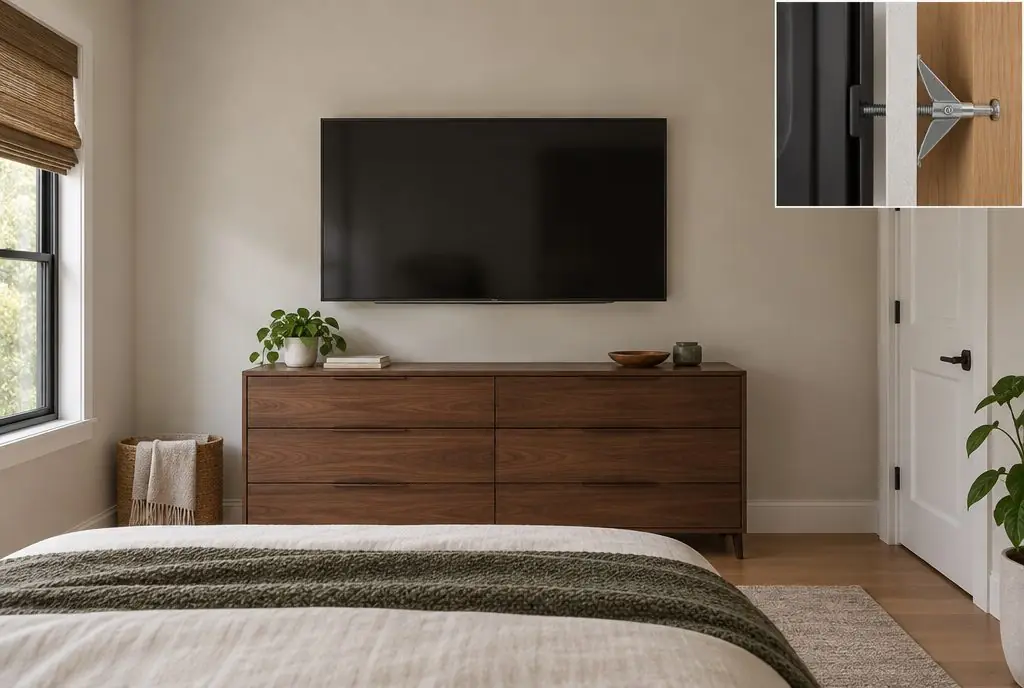 Illustration
Yes — with rated toggle anchors, never with plastic plugs
A flat-screen TV can be mounted safely on drywall with no stud behind the bracket, but only with anchors engineered for hollow walls and rated with a wide margin above the TV's weight. The anchors in a TV mount's hardware bag are usually lag screws for wood studs; the small plastic expansion plugs sold at checkout counters are for picture frames and fail under the levering load a TV puts on a wall.
The correct hardware is a heavy-duty toggle anchor — the kind with a steel channel that swings open behind the drywall and a threaded bolt that clamps the bracket against it. Properly installed in half-inch drywall, each of these anchors is rated in the range of 80 to 250 pounds in shear, and a bracket uses four to six of them.
Why the stud is often in the wrong place
Wood studs sit 16 inches apart in most Santa Clarita Valley homes, 24 inches in some garages and newer energy-framed walls. A fixed or tilting mount's wall plate is designed to span two studs, so on a 16-inch layout it usually works. The trouble starts when the TV needs to be centered on a wall, over a dresser or between two windows and the studs fall on either side of that center point.
Full-motion arms are worse: a single-arm mount has a narrow plate meant for one stud, and if the only stud is six inches off-center the arm's reach has to compensate. Rather than compromise placement, an installer anchors the plate where the room wants the TV and uses toggles for whichever bolt holes miss framing — a mix of lag screws into the stud and toggles in the hollow is common and perfectly sound.
How a toggle anchor holds and what the rating means
A toggle anchor works by bearing on the back face of the drywall over a wide area instead of gripping the edge of a hole. The installer drills a half-inch hole, feeds the folded metal channel through, pulls it flat against the back of the board with the plastic straps, snaps the straps off and runs the machine bolt through the bracket into the channel. The bracket is then tightened until snug, not crushed, because over-tightening cracks the gypsum core.
Ratings on the package are ultimate loads from a laboratory pull test; installers divide by at least four for a safe working load, so an anchor marked 240 pounds is treated as good for about 60. Four of them carry a 65-inch TV weighing 50 to 70 pounds with room to spare, and the drywall itself — not the anchor — becomes the limiting part.
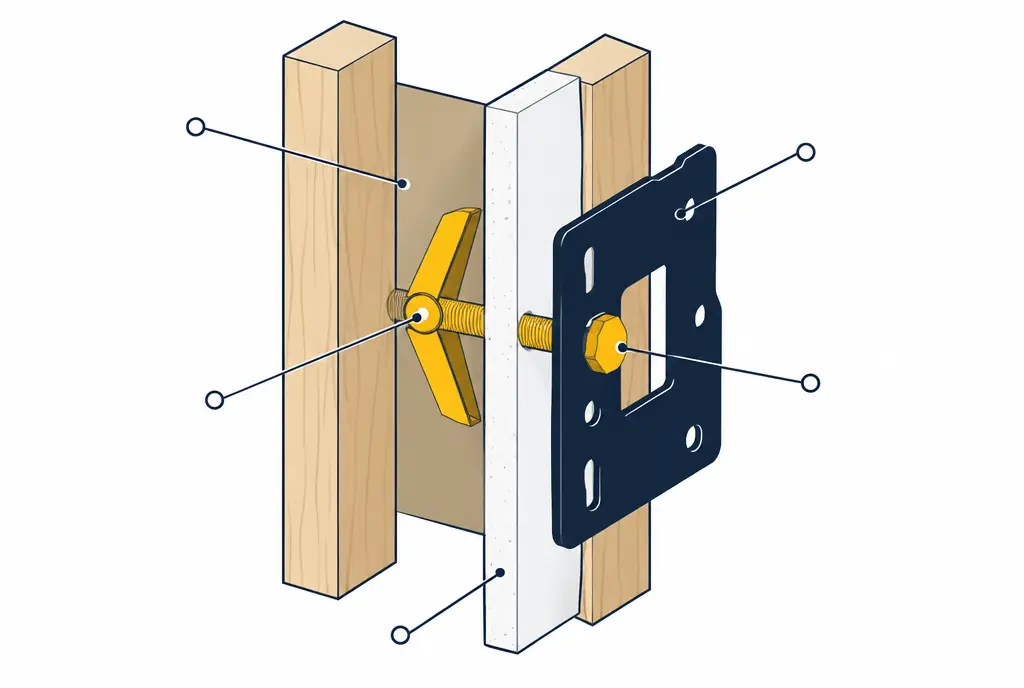
What the callout markers point to
- The wings open flat against the back of the drywall, so the load spreads over a wide area instead of one hole.
- Rated toggles hold far more than plastic plugs or self-drilling anchors, which are never used for a TV.
- A stud is still preferred when one is in reach; toggles are the engineered fallback.
Steel studs in Newhall condos and newer builds
Condominiums and apartments around Old Town Newhall and along the valley's newer mixed-use corridors are often framed with light-gauge steel studs. Steel studs read as metal on a stud finder but will not hold a lag screw: the thread strips out of the thin flange. The fix is the same toggle anchor, drilled through the drywall and through the stud flange so the channel opens inside the C-shaped stud, or a snap-toggle sized for the combined thickness.
Self-drilling steel-stud screws are an alternative for light loads. Either way, the stud still provides the location and the toggle provides the holding power. Homeowner associations sometimes restrict drilling into shared walls; where that applies, the mount goes on an interior partition.
When a backer plate is the better answer
For very large or very heavy TVs — 85 inches and up, or older plasma sets — or for full-motion arms that put the whole weight 20 inches off the wall, a toggle-only mount is possible but a backer spreads the load better. A painted 3/4-inch plywood plate, or a steel mounting plate sold for this purpose, is screwed into whatever studs are reachable across a wider span, and the TV bracket is then bolted anywhere on that plate.
The plate can be painted to match the wall or hidden behind the TV entirely. In a home where the wall will be opened anyway for in-wall wiring, a short piece of blocking between studs does the same job invisibly.
Earthquake country: the margin that matters
Southern California shakes, and a TV on a wall is a cantilevered mass that a moderate quake will rattle. This is the practical reason installers in the valley insist on rated anchors, four or more fastening points and a bracket that locks the TV to the arms with safety screws rather than gravity hooks alone. Fixed and tilting mounts ride out shaking better than extended full-motion arms, which is one reason an arm is parked flat against the wall when not in use. None of this needs special hardware; it needs the correct hardware installed as the manufacturer intends.
What the no-stud situation adds to the price in Santa Clarita
A mount on steel studs or on drywall with no stud at the TV's location typically adds $20 to $40 to a standard installation in the local market, covering the toggle anchors and the extra drilling and checking. A backer plate adds material and time on top of that. The estimator below includes the steel-stud and no-stud wall option so the range reflects it.
Where this leads
- Service page: TV Mounting on Metal Studs & Drywall Without Studs — Toggle anchors sized to the stud gauge or a hidden backer plate when the studs aren't where the TV needs to be.
- Local page: TV mounting in Newhall
- All services and typical prices: TV mounting in Santa Clarita
- More illustrated guides: Mounting Ideas & Guides
Check availability and the price range for this setup
Bookings aren't open yet — tell us about the TV and the wall. You get a Santa Clarita price range on the next screen. Typical Santa Clarita Valley prices for one TV, labor only unless an option says otherwise. This is a market estimate, not a quote.