
Santa Clarita TV Mounting: Project example: a 55-inch TV centered over a console on a steel-stud condo wall — what it looks like and what it costs
Santa Clarita TV Mounting sets out a typical bedroom-wall project in a condo near Valencia Town Center: a 55-inch TV on a low-profile fixed mount, centered over a 60-inch dresser on a wall framed with light-gauge steel studs that do not line up with the center, so the bracket is held by heavy-duty toggle anchors instead of lag screws.
Project Examples & Typical Prices
Worked example. The pictures are AI concept illustrations, not photographs; no installation was performed or arranged through this site; prices are typical Santa Clarita Valley market ranges, not quotes.
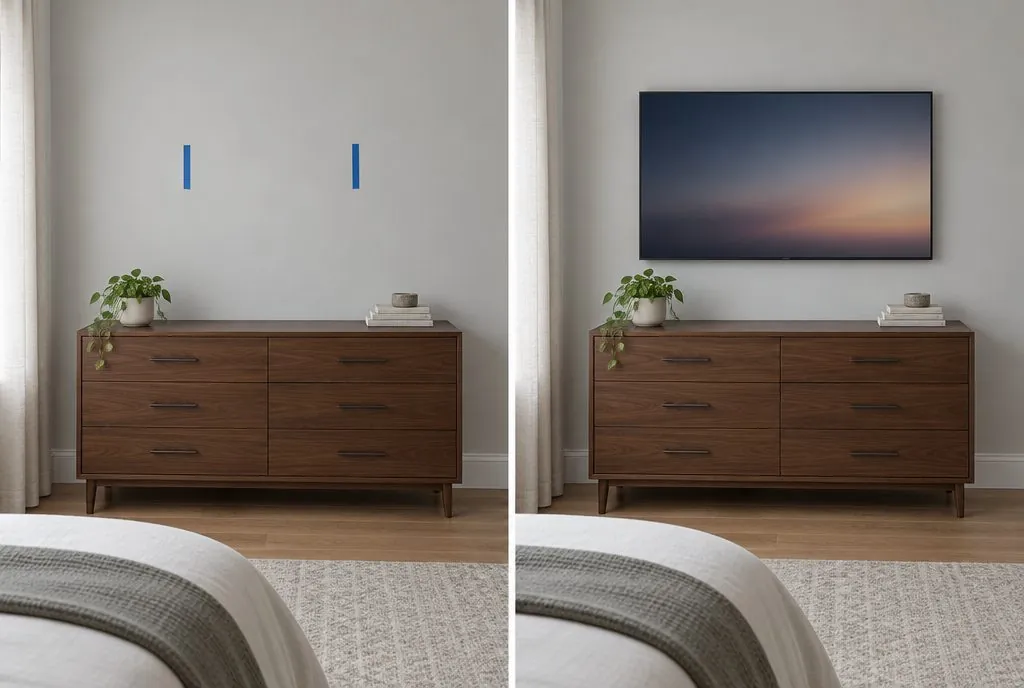 Illustration
Starting pointFinished layout (concept)
Illustration
Starting pointFinished layout (concept)
The scenario
The room is a primary bedroom in one of the condo and townhome buildings around Valencia Town Center, the kind framed with light-gauge steel studs behind half-inch drywall rather than wood. A 60-inch walnut dresser sits against the wall opposite the bed, and the TV is meant to be centered over it at a height that works from pillows propped against the headboard, about 9 feet away. A stud finder shows metal at 16-inch spacing, but the two nearest studs fall 5 inches left and 11 inches right of the dresser's center — neither lines up with where a single-stud bracket would need to go, and a two-stud plate would put the TV visibly off-center.
The condo association allows TVs on interior partition walls but not on the party wall shared with the neighbor; this wall is an interior one. The outlet is low behind the dresser, so the power cord and a single HDMI can drop straight down behind the furniture without any concealment work. What the job turns on is the anchoring: steel studs do not hold lag screws, and the center of the wall is hollow, so the bracket has to be carried by toggle anchors rated well above the TV's weight.
What the job involves
- The installer sweeps the wall with a stud finder set to metal detection and marks the two steel studs with tape, then confirms the wall is interior rather than a shared party wall and that nothing — no plumbing, no conduit — runs behind the planned bracket location.
- The screen center is marked over the dresser's center line, and the height is set from the bed: the middle of the screen a little above a propped-up eye line, checked with painter's tape before drilling.
- The fixed mount's wall plate is held on the marks and leveled; of its four bolt positions, one lands on a steel stud flange and three land in hollow drywall, so each position is marked for the right anchor.
- Half-inch holes are drilled at the three hollow positions and a heavy-duty toggle is fed through each: the steel channel swings open behind the drywall, is pulled flat with the straps, the straps are snapped off and the bolt is run through the plate. The stud position gets a toggle as well, drilled through the stud's thin flange so the channel opens inside the C-shaped stud.
- All four bolts are tightened until snug — not crushed, since over-tightening cracks the gypsum — and the plate is pull-tested by hand with the installer's full weight leaning back on it.
- The TV is hung on the plate, secured with its safety screws, and the power cord and HDMI lead are dropped behind the dresser to the outlet with a short cable sleeve to keep them tidy.
Hardware and materials
- Low-profile fixed wall mount for 32–65 inch panels, with a four-hole wall plate and safety-lock screws
- Four heavy-duty toggle anchors (steel channel type) sized for half-inch drywall and a steel-stud flange, each rated far above the share of a 55-inch TV's weight it carries
- Stud finder with metal mode, laser level, half-inch drill bit
- Short HDMI lead and a fabric cable sleeve for the drop behind the dresser
- Torque-aware hand driver for the toggle bolts — no impact driver on drywall anchors
What it typically costs in the Santa Clarita Valley
| 50–65 inch TV, standard wall mount (labor) | $119–$149 |
| Steel studs or no stud where the TV goes | +$20–$40 |
| Typical total | $139–$189 (market range, not a quote) |
These are typical local ranges, not a quote or an offer; an installer prices the actual job after seeing the wall.
Add-ons often paired with this job
- Mount a soundbar as well — +$49–$79. A soundbar bracket under the TV suits a bedroom where the dresser top should stay clear; it needs two more toggles.
- Hide the wires inside the wall — +$79–$149. If the cables should vanish entirely, an in-wall rated kit can be fished between studs — steel framing allows it, with grommets where cables pass a stud.
- I need the mount supplied — +$40–$120. When no bracket is on hand, the installer supplies a fixed or tilting mount matched to the TV's VESA pattern.
Why it is done this way
Centering the TV over the dresser matters more to the room than landing on a stud, and modern toggle anchors make that a sound choice: each one bears on a wide area of the back of the drywall and is rated in the hundreds of pounds, so four of them carry a 55-inch panel of roughly 40 pounds with a large margin. Dividing the package rating by four for a safe working load is the installer's habit, and even on that basis the anchors are not the limiting part of the wall.
A fixed mount is chosen because the TV faces the bed straight on and its height is already set from the pillows — there is nothing to tilt or swing. Lag screws are avoided entirely: a lag in a light-gauge steel flange strips out as it is driven, which is the most common failure on condo walls. Toggles through the flange turn the stud into a locating aid while the toggle does the holding.
What would change the price
- The chosen wall is the party wall shared with a neighbor and the association prohibits drilling there — the TV moves to another wall or goes on a stand, and the job is re-scoped.
- A plumbing or conduit run sits behind the bracket location — the plate shifts a few inches or the TV is re-centered, and the layout is re-marked.
- A full-motion arm instead of a fixed mount — the arm's cantilever load calls for a plywood or steel backer plate across two studs, adding material and time.
- In-wall concealment is added later — fishing cables through steel studs needs grommets at each flange and is priced as its own line.
- A 65-inch panel at the top of this size tier — the base rate stays in the same bracket, but a six-hole plate with two more toggles may be used.
Where this leads
- Service page: TV Mounting on Metal Studs & Drywall Without Studs — Toggle anchors sized to the stud gauge or a hidden backer plate when the studs aren't where the TV needs to be.
- Local page: TV mounting in Valencia
- All services and typical prices: TV mounting in Santa Clarita
- More worked examples: Project Examples & Typical Prices
Check availability and the price range for this setup
Bookings aren't open yet — tell us about the TV and the wall. You get a Santa Clarita price range on the next screen. Typical Santa Clarita Valley prices for one TV, labor only unless an option says otherwise. This is a market estimate, not a quote.