
Santa Clarita TV Mounting: Project example: a 65-inch TV over a used-brick fireplace — what it looks like and what it costs
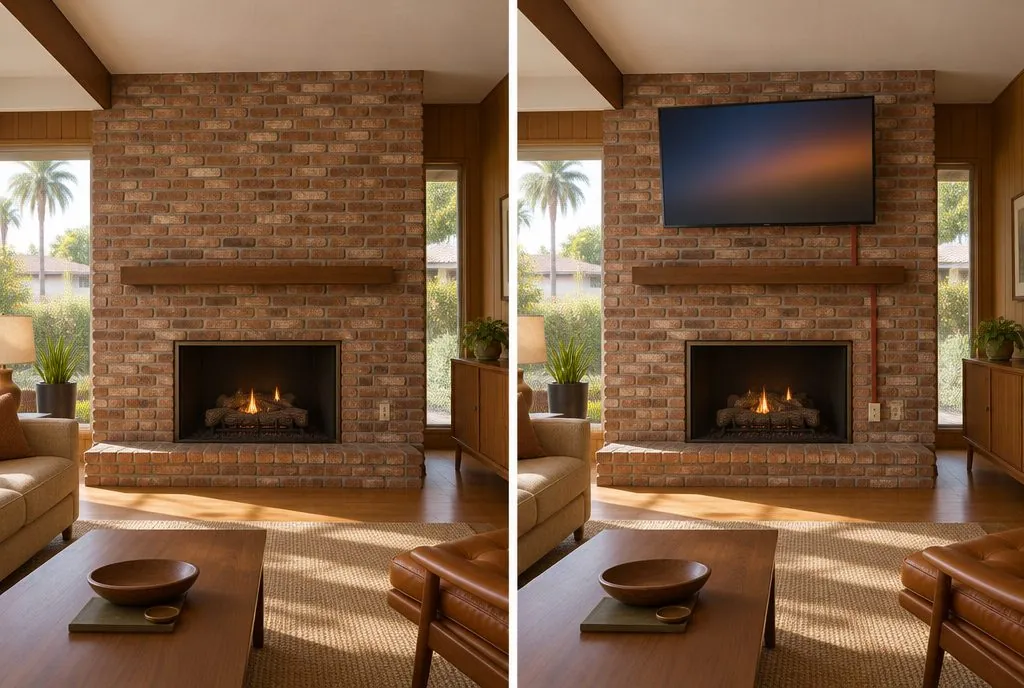
Santa Clarita TV Mounting walks through a typical over-fireplace project for a single-story Saugus ranch home: a 65-inch TV on a tilting bracket anchored into a used-brick chimney breast above a wood mantel, with the cables carried down the brick in a paint-matched raceway to the outlet beside the hearth.
Project Examples & Typical Prices
Worked example. The pictures are AI concept illustrations, not photographs; no installation was performed or arranged through this site; prices are typical Santa Clarita Valley market ranges, not quotes.
 Illustration
Starting pointFinished layout (concept)
Illustration
Starting pointFinished layout (concept)
The scenario
The setting is one of the single-story ranch homes built across Saugus in the 1970s and 1980s: an L-shaped living room with an 8-foot ceiling, a full-height used-brick fireplace on the long wall, a 6-inch-deep wood mantel at about 54 inches, and one duplex outlet in the brick a foot to the right of the firebox. The firebox holds a gas log set and is lit a few evenings a winter. The sofa sits 11 feet back, and there is no other wall in the room where a TV of any size would face the seating.
The request is the common one for this floor plan: a 65-inch TV above the mantel, a picture that is watchable from the sofa without craning, no cords dangling down the brick, and no damage to the mantel. The used brick is real masonry — a full wythe of clay brick on the face of a framed chase — so the anchoring goes into the brick itself. Because the firebox is used, the mounting height is set by a heat check rather than by taste, and a tilting bracket makes up the difference between that height and eye level.
What the job involves
- The installer confirms the brick is solid, not a thin veneer panel, by checking the depth at the firebox opening and the sound of the brick when tapped, then runs the heat test: with the gas logs on for an hour, a thermometer taped at the planned bottom edge of the TV has to stay under the panel's operating limit.
- The viewing height is set from the sofa, not the floor: a strip of painter's tape marks the bottom edge of the TV a few inches above the mantel, and the center of the screen is checked against a seated eye line from 11 feet before anything is drilled.
- The bracket's wall plate is held against the brick and its slotted holes are shifted so every anchor lands in the body of a brick, never in a mortar joint; the four positions are marked and the plate is leveled with a laser.
- Holes are drilled with a hammer drill and a carbide bit sized to the sleeve anchors, with a vacuum shroud catching the brick dust; the anchors are set, the plate is bolted down, and the plate is pull-tested by hand before the TV goes anywhere near it.
- A paintable raceway base is screwed to the brick along a vertical mortar line from the plate down to the outlet; the TV's power cord and an HDMI lead are laid in it and the cover is snapped on, then the raceway is painted brick red on the brick faces and mortar gray across the joints.
- The TV is hung on the plate, locked with its safety screws, tilted down toward the sofa until the reflection from the front window is out of the picture, and the room is vacuumed and wiped down.
Hardware and materials
- Tilting wall mount rated for 50–75 inch panels and at least 1.5 times the TV's weight, with slotted holes for masonry layout
- Four 3/8-inch sleeve anchors for solid brick, with matching carbide masonry bit and hammer drill
- Laser level and a thermometer for the heat check above the mantel
- Low-profile paintable cable raceway, 6 to 8 feet, with masonry screws and an end cap at the outlet
- Brick-red and mortar-gray latex paint for the raceway; a 6-foot high-speed HDMI lead and the TV's own power cord
- Vacuum with a drilling shroud, drop cloth for the hearth and mantel
What it typically costs in the Santa Clarita Valley
| 50–65 inch TV, standard wall mount (labor) | $119–$149 |
| Brick, stone or concrete | +$50–$80 |
| Above a fireplace | +$80–$120 |
| Typical total | $249–$349 (market range, not a quote) |
These are typical local ranges, not a quote or an offer; an installer prices the actual job after seeing the wall.
Add-ons often paired with this job
- Mount a soundbar as well — +$49–$79. A soundbar on a bracket under the TV keeps the mantel clear; on brick it shares the raceway for its power and optical lead.
- I need the mount supplied — +$40–$120. When no bracket has been bought yet, the installer supplies a tilting mount matched to the TV's VESA pattern and weight.
- Take down an existing TV first — +$40–$89. If an older TV is on a different wall, taking it down and patching the holes is a separate line item.
Why it is done this way
A fireplace that is actually lit is the only hard constraint in this room, which is why the heat test comes first and decides the height. Mounting as low as the mantel allows and then tilting the screen is the standard answer for an 8-foot ceiling: it keeps the picture within a comfortable upward angle from 11 feet while leaving the mantel usable. A pull-down mantel mount is the alternative when the mantel sits higher than this one, but it costs more and needs a swing path clear of decor.
The anchors go into brick rather than mortar because clay brick holds a sleeve anchor firmly and mortar can crumble over time. A raceway rather than in-wall concealment is the right call on masonry: there is no stud bay to fish, and cutting a channel into the brick would ruin the face of the fireplace. Painted to match, the raceway reads as another mortar line from the sofa.
What would change the price
- The heat test fails at the preferred height — the fix is a higher mount with more tilt, a heat-deflector shelf, or a pull-down mantel mount, which adds hardware and setup time.
- The brick turns out to be a thin veneer over drywall — the anchors then go through the veneer into the framing behind, and the masonry surcharge may not apply.
- The outlet is on the far side of the room — a longer raceway run or routing cables through the side of the chase to an adjacent drywall section changes the cable-management line.
- An 85-inch TV instead of a 65 — a larger size bracket moves the base rate to the next tier and may call for six anchors instead of four.
- Adding a new outlet behind the TV is licensed electrical work (C-10) and is priced separately by an electrician, not by the TV installer.
Where this leads
- Service page: TV Mounting on Brick, Stone & Concrete — Hammer-drilled sleeve or wedge anchors into brick, block, stone or poured concrete — no masonry screws alone.
- Local page: TV mounting in Saugus
- All services and typical prices: TV mounting in Santa Clarita
- More worked examples: Project Examples & Typical Prices
Check availability and the price range for this setup
Bookings aren't open yet — tell us about the TV and the wall. You get a Santa Clarita price range on the next screen. Typical Santa Clarita Valley prices for one TV, labor only unless an option says otherwise. This is a market estimate, not a quote.