
Can You Mount a TV on a Brick Fireplace?
Santa Clarita TV Mounting explains how a TV is mounted on a brick fireplace in Santa Clarita Valley homes — the anchors that hold in solid brick, the heat check above the mantel, and the mount styles that keep the picture watchable from the couch.
Bookings aren't open yet. Leave your name and number; your message is recorded, and you'll get one message when a local installer is available.
The wall as it starts
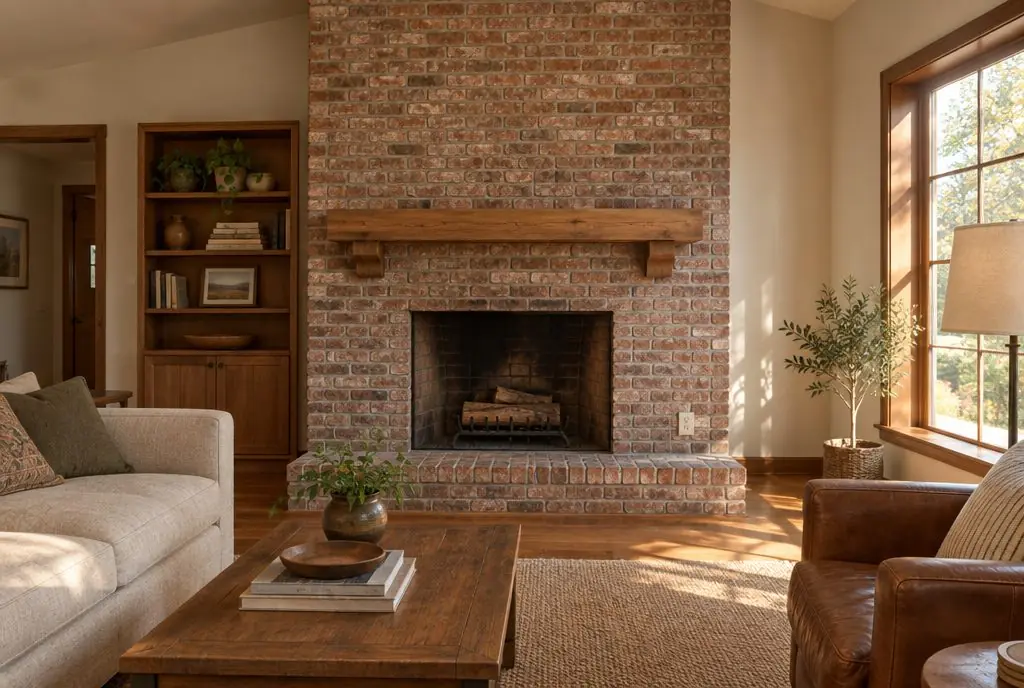 Illustration
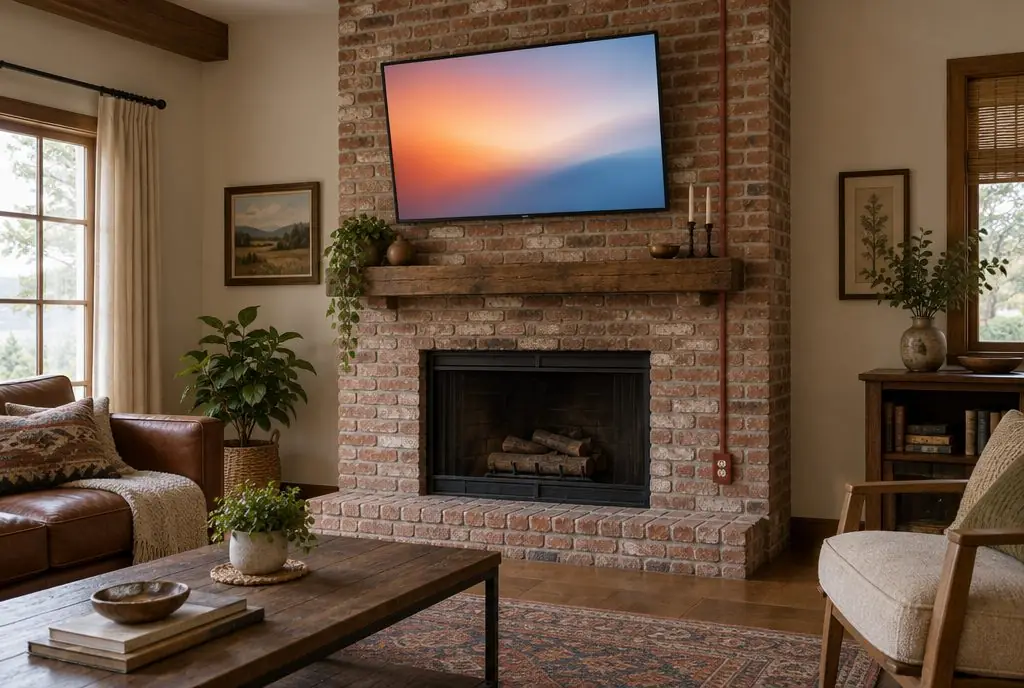
The finished look (illustration)
 Illustration
Yes — when the brick is solid and the anchors are rated for masonry
Brick is one of the strongest surfaces in a house for a TV mount, provided three things are true: the brick is a real masonry wall or a full-depth veneer rather than thin brick tile glued to drywall, the anchors are designed for masonry, and the holes land in brick rather than crumbling mortar. A typical used-brick fireplace in a Saugus or Newhall ranch home has a full wythe of clay brick in front of a framed chase, and that brick carries a 75-inch TV without complaint.
The failure cases come from the wrong hardware: drywall anchors tapped into a mortar joint, or lag screws driven into brick without a sleeve. Thin brick veneer — common in newer homes where the fireplace surround is a decorative panel — is a different situation. The veneer is only about half an inch thick, so the installer drills through it and anchors into the framing or backer behind, treating the brick as a finish rather than a structure.
Brick or mortar: where the holes go
Clay brick is dense and holds a sleeve anchor or wedge anchor firmly; mortar is softer, varies in quality and can crumble around an anchor over time. A careful installer lays the bracket against the wall, marks the four or six bolt positions, then shifts the plate up or down an inch so every hole lands in the body of a brick rather than a joint. Most wall plates have slotted holes for exactly this reason.
The holes are drilled with a hammer drill and a carbide masonry bit matched to the anchor, usually 3/8 or 1/2 inch, with a vacuum shroud to catch the red dust before it settles on the hearth. Sleeve anchors expand as the bolt is tightened and are the standard choice for brick; wedge anchors suit solid concrete; for soft, old or painted brick a chemical anchor set in epoxy spreads the load across more of the brick. Each anchor is rated in hundreds of pounds, so a four-anchor plate holds many times the weight of any consumer TV.
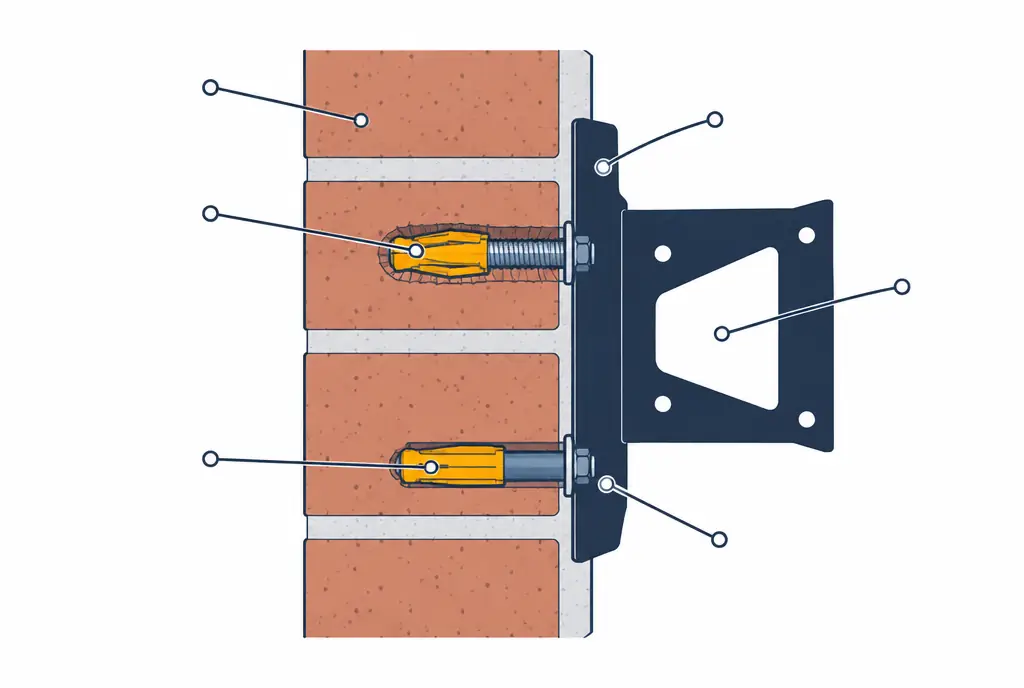
What the callout markers point to
- The cutaway shows the sleeve expanding as the bolt is tightened, locking into the brick.
- Mortar is softer and crumbles, so anchors go into the body of the brick.
- The same hardware carries over to concrete block and poured concrete with the right drill bit.
Heat and the mantel: the check that comes first
A fireplace that actually gets used is the real limit, not the brick. TV manufacturers specify an operating ceiling of around 95 to 104°F at the back of the panel, and the air above a working firebox can run well past that. The test is simple: with the fire going for an hour, a thermometer is taped at the spot where the bottom of the TV will sit. If the reading climbs above the TV's limit, the options are to mount higher, add a deeper mantel or heat-deflector shelf, or choose a pull-down mount that lives above the heat and lowers the screen only when the fire is off.
In the Santa Clarita Valley many brick fireplaces are gas inserts or purely decorative and rarely lit, which makes the heat question easier, but the check still happens because it decides the mounting height. A mantel also sets a geometric limit: the bracket must clear it, and a tilting mount needs room to angle downward without the top of the TV touching the brick.
Mount styles that work on a fireplace wall
Three bracket types cover almost every brick fireplace. A fixed low-profile mount holds the TV an inch or two off the brick and looks cleanest, but it only makes sense when the screen can sit near eye level. A tilting mount angles the screen down five to fifteen degrees, which cuts glare from windows and improves the picture when the TV sits above a mantel. A pull-down mantel mount is the premium answer: the TV parks above the fireplace and swings down and forward to sit in front of the mantel at couch height, then goes back up when the room is used differently.
Full-motion articulating arms are used less often on fireplaces because the chase behind the brick rarely needs the TV to swing sideways. Whatever the style, the wall plate is bolted to brick, not to the mantel, and the bracket is load-tested by hand before the TV is hung.
Where the wires go when the wall is brick
Brick cannot be fished the way drywall can, so cables are managed on the surface or around the fireplace. The usual solution is a slim paintable raceway running from the TV down to an outlet beside the hearth, painted brick red or the mortar's gray so it reads as another joint. Where the fireplace is a framed chase with brick only on the face, an installer can sometimes route cables through the side of the chase into an adjacent drywall section and come out at a console.
Adding a new outlet behind the TV is electrical work that an electrician handles; a TV installer runs only low-voltage HDMI and the TV's own power cord. The cable raceway guide goes through the options in detail.
What a brick fireplace mount typically costs in the Santa Clarita Valley
Masonry adds labor and consumables: the hammer drilling, the anchors, the dust control and the raceway. Local pricing for a brick or stone fireplace mount typically runs $50 to $80 above a plain drywall job, so a 65-inch TV on a used-brick fireplace with a tilting mount and a painted raceway generally lands in the $200 to $280 range, with a pull-down mantel mount adding more for the hardware and the extra setup.
The estimator below shows the current typical range for a specific TV size and set of options. The one thing that reliably raises the price is heat: if the thermometer test fails, the fix is a different mount or a deflector shelf, not a shortcut.
Where this leads
- Service page: TV Mounting on Brick, Stone & Concrete — Hammer-drilled sleeve or wedge anchors into brick, block, stone or poured concrete — no masonry screws alone.
- Local page: TV mounting in Saugus
- All services and typical prices: TV mounting in Santa Clarita
- More illustrated guides: Mounting Ideas & Guides
Check availability and the price range for this setup
Bookings aren't open yet — tell us about the TV and the wall. You get a Santa Clarita price range on the next screen. Typical Santa Clarita Valley prices for one TV, labor only unless an option says otherwise. This is a market estimate, not a quote.