
Santa Clarita TV Mounting: Project example: a 65-inch Frame TV flush to the wall with the One Connect box hidden — what it looks like and what it costs
Santa Clarita TV Mounting describes a typical picture-frame TV project in a newer Stevenson Ranch home: a 65-inch Frame TV hung flush on its no-gap bracket over a low white console, the One Connect box tucked into a recessed in-wall box behind the console, with power and the single thin cable fished inside the drywall so the panel reads as a framed print.
Project Examples & Typical Prices
Worked example. The pictures are AI concept illustrations, not photographs; no installation was performed or arranged through this site; prices are typical Santa Clarita Valley market ranges, not quotes.
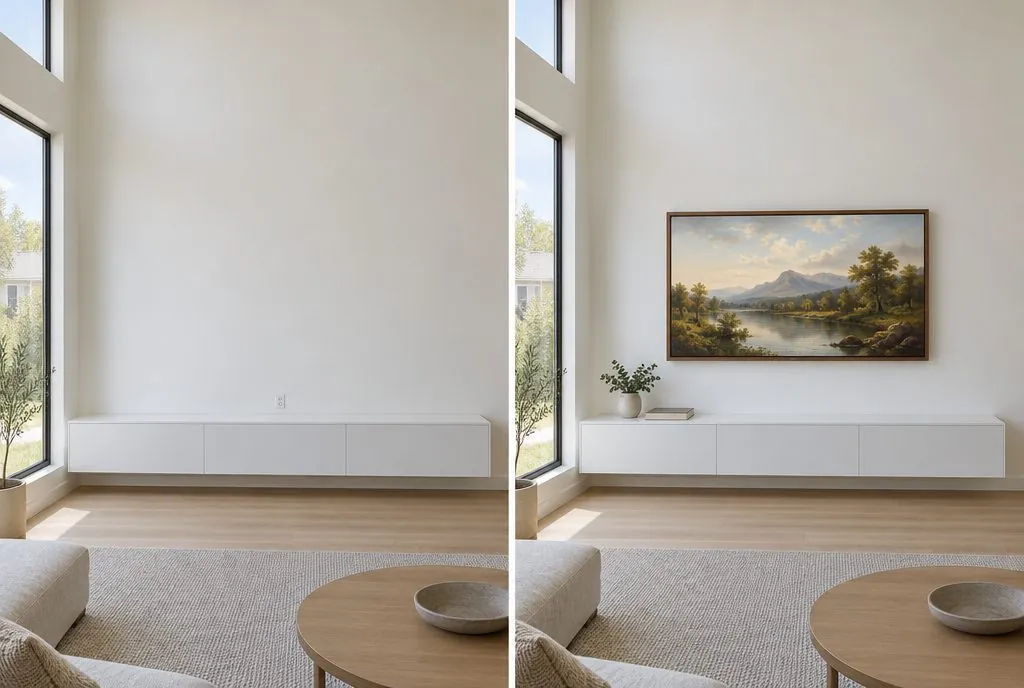 Illustration
Starting pointFinished layout (concept)
Illustration
Starting pointFinished layout (concept)
The scenario
This one is a living room in one of the newer Stevenson Ranch neighborhoods: 12-foot ceilings, a plain white drywall wall framed on 16-inch wood studs, a low floating console already mounted on it, and a duplex outlet low on the wall behind the console. The room is the kind where a black rectangle would dominate, which is why the choice is a 65-inch Frame TV meant to hang like art, with a slim walnut bezel and a matte screen that shows paintings when nobody is watching.
What makes a Frame TV a distinct job is its architecture. The panel itself carries almost no electronics; everything — the HDMI inputs, the tuner, the power supply — lives in a separate One Connect box, and a single thin cable, barely thicker than a fishing line, carries picture and power from that box to the panel. The box has to be somewhere, the thin cable has to be invisible, and the panel's no-gap bracket means there is no room behind it for a cable loop. The sofa faces the wall from 10 feet, and the screen center is set low, at picture height, because the TV is meant to be looked at like a print.
What the job involves
- The installer unpacks the panel and the One Connect box, confirms the no-gap wall bracket that ships with the Frame is complete, and marks the panel's position: centered over the console, screen center at seated eye level, which for art-style mounting is lower than a conventional TV.
- Two studs are located and verified, the no-gap bracket is laser-leveled and lag-bolted into both, and the small gap the bracket leaves at the top for the thin cable's exit is marked.
- A recessed in-wall media box is cut into the drywall between studs behind the console, low enough to be hidden by it; the One Connect box slides into this recess with its ventilation clear, and a short HDMI from the game console and the streaming stick reach it there.
- An in-wall rated power kit is fitted: a recessed inlet in the media box, fed by the existing outlet behind the console, so the One Connect box plugs in inside the wall without any extension cord in the cavity.
- The thin invisible cable is fished up the stud bay from the media box to the opening behind the panel with a fish tape, protected from the drywall edge with a grommet, and its connector is seated on the panel while it is on padding on the floor.
- The panel is hung on the no-gap bracket and pressed flush, the bezel is clicked on, Art Mode and the motion sensor are set up on the room's Wi-Fi, and the console, floor and recess trim are wiped free of dust.
Hardware and materials
- The Frame's own no-gap wall bracket and the One Connect box, as shipped with the panel
- Recessed in-wall media box with trim ring and ventilation slots, sized for the One Connect box
- In-wall rated recessed power kit (inlet behind the console, outlet in the media box)
- Fish tape, drywall saw, stud-edge grommet, laser level and lag bolts for two studs
- Thin invisible cable of the length that ships with the TV; a longer version when the run exceeds it
- Magnetic walnut bezel for the panel, fitted after hanging
What it typically costs in the Santa Clarita Valley
| 50–65 inch TV, standard wall mount (labor) | $119–$149 |
| Hide the wires inside the wall | +$79–$149 |
| Typical total | $198–$298 (market range, not a quote) |
These are typical local ranges, not a quote or an offer; an installer prices the actual job after seeing the wall.
Add-ons often paired with this job
- Mount a soundbar as well — +$49–$79. A slim soundbar under a Frame TV is the usual trade-off between a clean wall and real sound; its cable runs back to the same recess.
- Take down an existing TV first — +$40–$89. The conventional TV the Frame replaces usually comes down from the same wall first, and its old bracket holes are patched before the no-gap plate goes up.
- I need the mount supplied — +$40–$120. Not applicable in the usual case — the no-gap bracket ships with the panel — but an older Frame without one needs a compatible bracket supplied.
Why it is done this way
The point of a Frame TV is to disappear into the wall, and that only happens when the One Connect box and the cable disappear too. Leaving the box on the console with the thin cable running down the wall defeats the purchase; sitting the panel on a standard bracket leaves a shadow gap the design is meant to avoid. The recessed media box behind the console is the cleanest home for the electronics: ventilated, reachable, and invisible once the console is back in place.
Fishing the thin cable through the stud bay is routine on a wood-framed drywall wall like this one, which is why the job is scoped as an in-wall concealment rather than a surface raceway. The power kit is non-negotiable — a cord run inside the cavity to the box would be a code violation. The low mounting height is deliberate: a Frame is placed where a painting would hang, not where a television usually does.
What would change the price
- The wall is a party wall, an exterior wall with insulation, or has fire-blocking between the box and the panel — the fish gets harder or the box moves to a side wall.
- No outlet behind the console — a new outlet is licensed electrician's work, priced separately, before the in-wall kit can be fitted.
- The thin cable needs to be longer than the one in the box — a longer invisible cable is bought as a part.
- A 75-inch Frame instead of a 65 — the base rate moves up a size tier and the no-gap bracket for that size is used.
- The console sits on legs rather than floating — the media box recess moves higher and a trim ring in the wall color keeps it discreet.
Where this leads
- Service page: Samsung Frame TV Installation — No-gap wall mount, One Connect box hidden, the thin invisible cable fished in-wall, bezel and Art Mode set up.
- Local page: TV mounting in Stevenson Ranch
- All services and typical prices: TV mounting in Santa Clarita
- More worked examples: Project Examples & Typical Prices
Check availability and the price range for this setup
Bookings aren't open yet — tell us about the TV and the wall. You get a Santa Clarita price range on the next screen. Typical Santa Clarita Valley prices for one TV, labor only unless an option says otherwise. This is a market estimate, not a quote.